
France holds a singular position in the Mediterranean yacht charter landscape. The Côte d’Azur has defined superyacht culture for decades — its marinas, its events, its particular blend of glamour and ease are without comparison. But a charter along the French coast offers far more than the well-known sequence of Monaco, Cannes, and Saint-Tropez. To the west, the Îles d’Hyères introduce a quieter, more grounded character: car-free islands, protected national park waters, and anchorages that feel entirely removed from the Riviera’s social rhythm. Corsica stands apart entirely — wilder and more elemental, shaped by ancient forests, granite coastlines, and a cultural identity that owes little to the mainland.
Phoenix Charter Brokers have curated a personalised guide on the best destinations to visit during a yacht charter in France.
THE FRENCH RIVIERA
The Côte d’Azur stretches from the Italian border at Menton westward to Saint-Tropez, and no coastline in the world concentrates as much yachting infrastructure, culinary ambition, and social energy into a comparable stretch. The timing of a Riviera charter matters as much as the itinerary: May and June offer warm conditions with significantly less people, September brings the Monaco Yacht Show and a return to measured pace, while July and August deliver the full intensity of the season — busier anchorages, higher berth demand, and a coastline at its most alive.
WHERE TO ANCHOR
Monaco | Port Hercule remains the defining berth of the Riviera season. The principality is compact and walkable — the casino, the Prince’s Palace, the Oceanographic Museum, and some of the finest restaurants on the Mediterranean coast are all within reach on foot. During Grand Prix week in May, the circuit wraps directly around the harbour and a berth in Port Hercule becomes one of the most coveted positions in yachting. Out of season, Monaco adapts to a slower pace; quieter streets, the same quality at table, and the views unchanged.
Saint-Jean-Cap-Ferrat | The Cap Ferrat peninsula sits between Monaco and Nice and carries a different environment. Often described as the billionaire’s peninsula, its calm bays and sheltered anchorages are among the clearest on the coast. The Villa Ephrussi de Rothschild, set above the water with views across both bays, is worth the visit for the gardens alone. The pace here is calm and the water exceptional — it works well as a counterpoint to Monaco, ideally in sequence.
Antibes & Cap d’Antibes | Port Vauban in Antibes is the largest marina on the Mediterranean and the operational centre of the Riviera for many superyachts. The old town is immediately rewarding, home to the Musée Picasso, set within the medieval Château Grimaldi, is one of the better museum experiences on the coast. Cap d’Antibes itself curves south from the town in a quiet arc of art deco villas and densely wooded headland. The anchorages at Baie de la Garoupe and along the Cap’s eastern shore are sheltered, clear, and largely free of the traffic that defines the marinas to either side.
Cannes & the Îles de Lérins | Cannes requires timing: the Film Festival in May and the Cannes Lions in June bring a particular energy that can be planned around or avoided, depending on preference. The Croisette has its appeal, and the old town of Le Suquet above the harbour offers a quieter, more textured alternative. A mile offshore, the Îles de Lérins provide complete contrast. Île Sainte-Marguerite — where the Man in the Iron Mask was allegedly imprisoned — is ringed by sheltered coves, eucalyptus groves, and some of the clearest snorkelling on the Riviera. Its neighbour, Île Saint-Honorat, is home to a working Cistercian monastery, vineyards producing wine the monks have cultivated for centuries, and a single restaurant, La Tonnelle, accessible only from the water. Both islands are served by limited ferry and best experienced by yacht, after the day visitors have gone.
Saint-Tropez | The Vieux Port defines Saint-Tropez in the way few ports define a place — superyachts moored stern-to along the quay, the daily market at Place des Lices, the Annonciade museum holding one of the finest collections of Post-Impressionist work in France. Pampelonne Beach, reached easily by tender, remains the definitive beach club experience on the Riviera: Club 55 for long lunches; Nikki Beach for something louder and more immediate. In October, the Voiles de Saint-Tropez draws the finest classic and modern racing yachts in the world — one of the most worthwhile events on the Mediterranean calendar to time a charter around.
Villefranche-sur-Mer | Regularly overlooked in favour of its more prominent neighbours, Villefranche holds one of the deepest natural anchorages on the entire Côte d’Azur — dramatic, well-sheltered, and flanked by hills that drop steeply to the water. The medieval Rue Obscure runs beneath the old town entirely covered — a vaulted passageway unchanged since the 13th century. The atmosphere is more composed than Nice or Cannes, and the bay itself is one of the most striking anchorages on the coast.
DINING EXPERIENCES
Le Louis XV – Alain Ducasse, Monaco | Three Michelin stars, set within the Hôtel de Paris overlooking the Casino gardens. One of the longest-established and most authoritative restaurant addresses in Europe, built around Mediterranean produce treated with absolute precision. The approach is described as “Naturalité” — an emphasis on ingredient integrity over technical theatrics. The setting is formal without being stiff, and the experience is inseparable from Monaco itself. Book well in advance.
La Vague d’Or, Saint-Tropez | Three Michelin stars, set within the Cheval Blanc Saint-Tropez on the Plage de la Bouillaboisse. Chef Arnaud Donckele’s cooking is rooted in the produce and culinary memory of Provence — blue lobster, local herbs, restraint applied with confidence. The terrace, surrounded by umbrella pines above the bay, is one of the defining tables on the French coast. Dinner here works naturally as a conclusion to a day at anchor in the Gulf of Saint-Tropez.
Mirazur, Menton | Three Michelin stars, positioned at the far eastern end of the Riviera near the Italian border. Chef Mauro Colagreco’s cooking draws from the restaurant’s own terraced gardens above the sea, with dishes shaped around what is growing rather than what is fashionable. The experience justifies the detour from the main Riviera sequence — it is one of the most considered and distinctive restaurants in Europe, and holds a rare integrity of place.
La Chèvre d’Or, Èze | Reached via a short transfer inland from the coast, the medieval village of Èze sits high above the sea with one of the most arresting views on the entire Riviera. La Chèvre d’Or, set within the village itself, holds two Michelin stars and frames that view as part of the meal — the coastline falling away below, the horizon open. The cuisine is precise, the setting unmatched for those willing to leave the water for an evening.
Club 55, Pampelonne Beach | Operating since 1955, it is the original beach club — simple by design, intentionally relaxed, built on the quality of its rosé, its grilled fish, and the shade of its terracotta-roofed terrace. Long lunches here settle naturally into late afternoons.
THE ÎLES D’HYÈRES
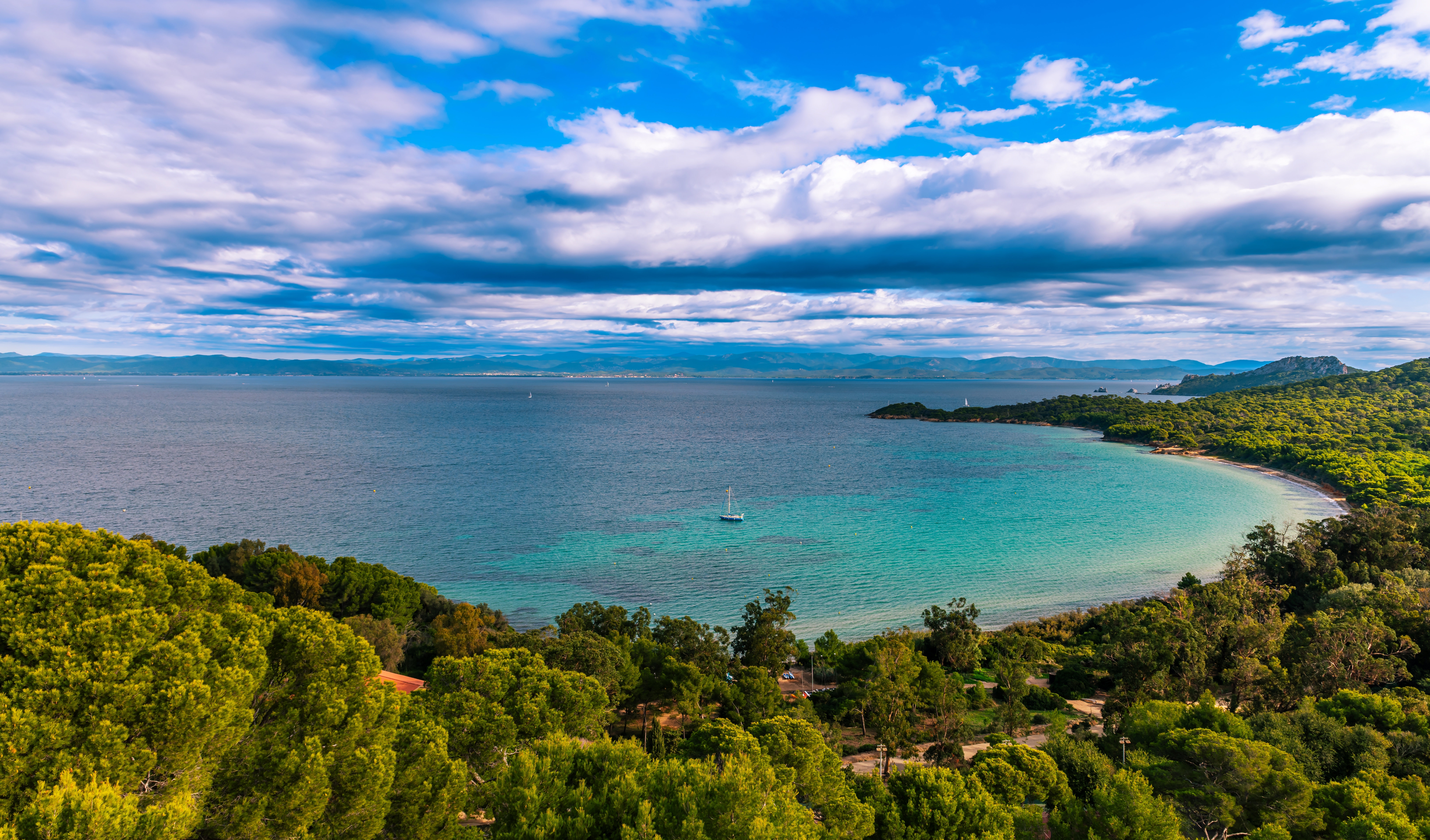
Lying between Saint-Tropez and Toulon, the Îles d’Hyères — Porquerolles, Port-Cros, and Île du Levant — occupy a position apart from the rest of the Riviera. No cars, no superyacht posturing, and in the case of Port-Cros, a protected national park with strict rules that have kept the marine environment in a condition rare for this stretch of coast. The water clarity changes noticeably as you approach from the mainland — deeper, less trafficked, the seabed visible well below the keel. These islands work equally well as a quiet stand-alone destination or as the natural western conclusion to a Riviera itinerary.
WHERE TO ANCHOR
Porquerolles | The largest of the three islands, and the most varied. The north shore holds three beaches of exceptional quality — Plage Notre-Dame, Plage de la Courtade, and Plage d’Argent — and anchorages that offer good holding in clear, turquoise water. The village at the centre of the island is deliberately low-key: a tree-lined square, a handful of cafés, locals playing pétanque. The interior is crossed by unpaved trails through vineyards and eucalyptus forest. Arriving by yacht, particularly in the shoulder season, allows the island to be experienced without the ferry day-trippers — the evenings especially, when it reverts entirely to those at anchor.
Port-Cros | Designated a national park both above and below the waterline, Port-Cros is among the most strictly protected anchorages in the Mediterranean. The restrictions are the point — the result is marine biodiversity that is simply not present elsewhere along this coast. Anchor in the main bay and snorkel straight from the platform into water of remarkable clarity. The hiking trails through dense, unchanged Mediterranean forest are among the most rewarding on any of the islands. The Bay of Port Man, on the island’s eastern side, is notably quiet and well-regarded for overnight stays.
DINING EXPERIENCES
L’Olivier at Le Mas du Langoustier, Porquerolles | One Michelin star, set within a traditional hotel on the island’s western headland, accessible only by boat or on foot. The position is entirely isolated — no road access, no day visitors. The menu follows the island and the season, built around local seafood and Provençal produce, served on a terrace that looks out across open water. It is the kind of table that exists precisely because of its difficulty to reach, and is worth planning a Porquerolles overnight specifically around.
CORSICA
Corsica does not belong entirely to the French Riviera charter circuit, nor to the Italian — it occupies a position apart, shaped by a landscape and culture that remain distinctly its own. The coastline shifts between dramatic granite headlands, deep maquis-covered hills descending to the water, and anchorages of a clarity that rivals the best in the Mediterranean. Napoleon was born in Ajaccio, and the island wears this history lightly — the birthplace remains, the old town retains its character, but Corsica is not defined by a single story. It is defined by its wildness and its resistance to easy categorisation.
WHERE TO ANCHOR
Ajaccio | The capital sits at the head of a wide gulf, with the old Genoese citadel visible from the water. Casa Buonaparte — Napoleon’s childhood home — is the obvious anchor point ashore, but the town itself rewards unhurried exploration: the covered market, the Place Foch with its fountain and café terraces, the Fesch Museum, which holds the most significant collection of Italian paintings in France outside the Louvre. The Gulf of Ajaccio, calm in summer and well-sheltered, provides a comfortable overnight position before continuing north or south along the coast.
Bonifacio | The southernmost town in France, built entirely on a limestone plateau above dramatic white cliffs that drop straight to the sea. From the water, Bonifacio is one of the most striking approaches in the Mediterranean — the old town perched at the cliff edge, the citadel cutting the sky above. The entrance to the inner harbour is narrow and requires careful navigation at low water, but once inside it is one of the most memorable berths on the island. The Bouches de Bonifacio — the strait separating Corsica from Sardinia — offers some of the most engaging sailing on either coast, with strong winds and challenging conditions that reward competent passage planning.
The Calanques de Piana | The most visually arresting section of the Corsican coastline, and one of the most distinctive in the entire Mediterranean. Rust-red granite formations — some rising directly from the sea, others piled into formations of improbable scale — line the coast between Porto and the Golfe de Girolata. The area is UNESCO-listed and entirely inaccessible by land at water level; it can only be properly understood from the sea. Anchor in the Golfe de Porto and explore by tender, moving through the formations in the early morning before conditions build. The light in the first hours after dawn changes the colour of the rock entirely.
Calvi | The most accessible of Corsica’s northern anchorages, with a well-equipped marina and a citadel that dominates the bay from its promontory. The Revellata Peninsula, a short distance south, offers quieter anchorages away from the town and some of the best diving on the island. Calvi works well as a northern starting point for a Corsican passage, or as a final stop before crossing to the French Riviera or Sardinia.
Saint-Florent & the Desert des Agriates | Saint-Florent is a modest port town on the northern coast with a character that sets it apart from the more developed marinas elsewhere. To the west lies the Desert des Agriates — an uninhabited stretch of protected coastline accessible only by sea, with beaches of a quality that would define any other destination: Loto and Saleccia are the most recognised, reachable only by tender and consistently quiet outside July and August. An overnight anchorage off the Agriates coast, with no infrastructure, no development, and a sky largely unaffected by light pollution, is among the more remote experiences available within a day’s sail of the French Riviera.
DINING EXPERIENCES
A Nepita, Ajaccio | Tucked away in Ajaccio’s old town, A Nepita is the restaurant of chef Simon Andrews, whose market-led cooking has made it one of Corsica’s most respected dining addresses. The menu changes frequently according to seasonal availability, though guests can expect refined interpretations of Corsican ingredients such as local red mullet, langoustine, veal, brocciu cheese, and wild herbs sourced from across the island.
Casadelmar, Porto-Vecchio | Overlooking the Gulf of Porto-Vecchio, Casadelmar is Corsica’s most celebrated gastronomic destination. Chef Fabio Bragagnolo’s cuisine is rooted in the Mediterranean, with standout dishes often centred around blue lobster, red tuna, line-caught fish, and premium seasonal vegetables. The tasting menus offer the most complete expression of the restaurant’s approach and are complemented by an exceptional wine cellar.
A Cantina di l’Orriu, Bonifacio | Located within Bonifacio’s citadel, A Cantina di l’Orriu presents traditional Corsican cuisine in a historic setting. Signature dishes typically include Corsican charcuterie platters featuring lonzu and coppa, slow-cooked wild boar, stuffed vegetables, local lamb, and desserts incorporating brocciu cheese. The extensive selection of Corsican wines provides an excellent introduction to the island’s vineyards.
BOOK YOUR YACHT CHARTER IN FRANCE
France offers more range than any comparable stretch of Mediterranean coastline. A week might move between the social intensity of Monaco and the Riviera’s key ports, the stillness of a Porquerolles anchorage, and the entirely different register of Corsica — three distinct experiences within a single, well-considered itinerary.
Phoenix Charter Brokers will curate a personalised yacht charter in France based on your preferences, the destinations you want to prioritise, and the pace you want to set. Contact us to begin planning your France yacht charter.